The Science of Obesity: Why It's Not Just Willpower
4 May 2026
Obesity is a complex, biologically-driven condition. Here's what the science actually says.
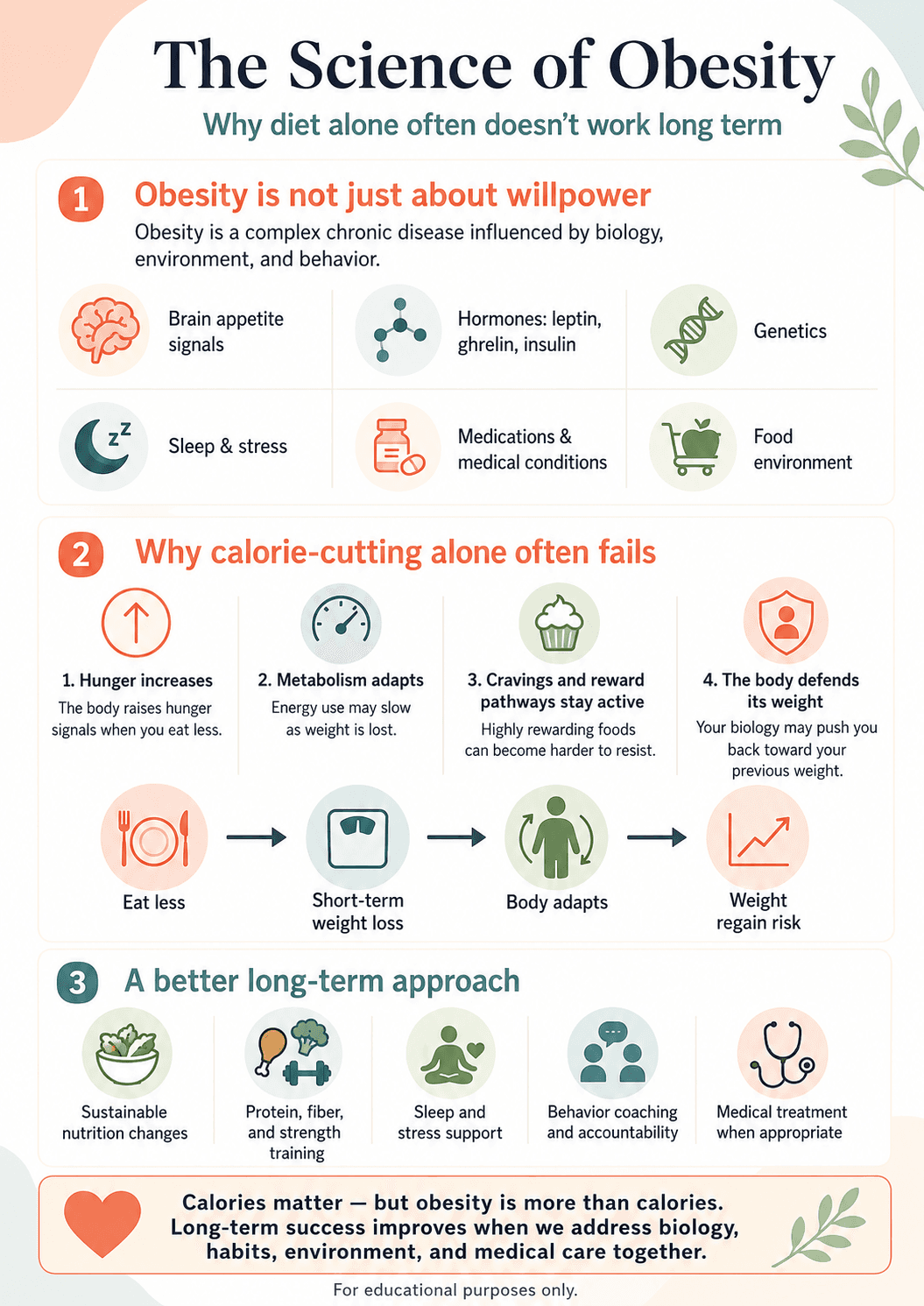
For decades, obesity was talked about as a simple equation: eat less, move more, and the weight comes off. If it doesn't, the thinking went, you just aren't trying hard enough.
That framing hasn't held up well against the actual science. Obesity is now understood as a chronic, relapsing condition shaped by genetics, hormones, brain chemistry, and environment.
Your body defends its weight
When you lose weight, your body doesn't just accept the new normal. Hormones that control hunger — like ghrelin and leptin — shift to make you hungrier and burn slightly fewer calories at rest, a process researchers call metabolic adaptation. This is one of the biggest reasons weight tends to come back after a diet ends: it reflects biology working against a lower body weight.
Genetics load the gun
Body weight is significantly heritable. Genes influence how hungry you feel, how efficiently your body stores fat, and how you respond to different foods. Two people can eat identical diets and end up at very different weights, because their underlying biology is different.
Why this matters for treatment
If obesity were purely a matter of discipline, medical treatment wouldn't be part of the conversation. But because it involves real hormonal and metabolic mechanisms, medical tools — including GLP-1 medications, nutrition science, and structured coaching — can address the biology directly.
That's also why a program that only hands you a meal plan and sends you on your way tends to underperform one that treats weight as the medical condition it is.
Curious how this applies to you specifically?
See how our Core Weight Loss Program works →